
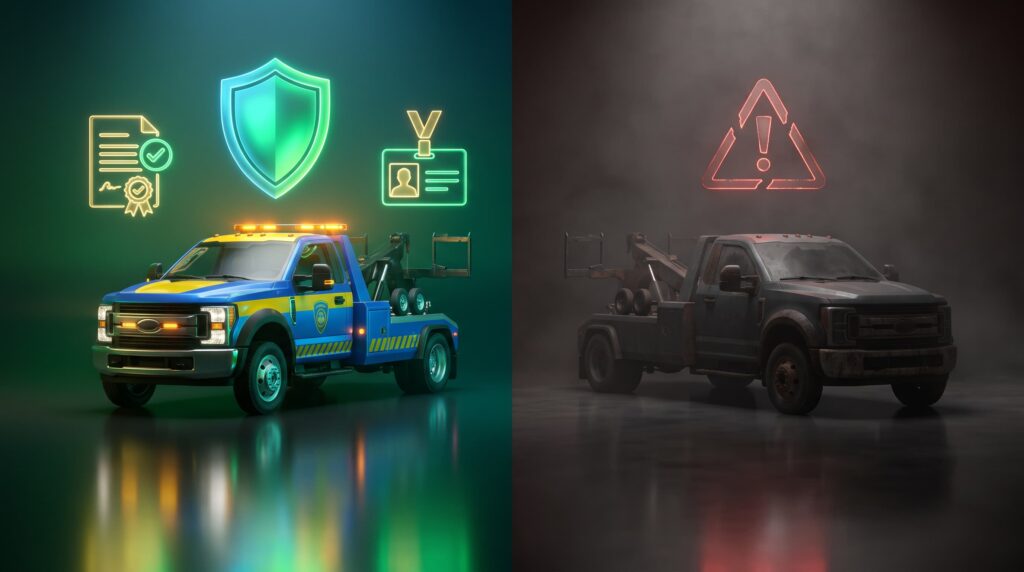
When a tow truck pulls up, most drivers never think to ask whether it is licensed. The truck looks official. It has a winch, flashing lights and a driver in a hurry. You hand over the key and hope for the best.
That gap in attention is exactly what a bad operator counts on. In the Tampa area, the difference between a licensed tow truck and an unlicensed one can mean the difference between a routine $160 tow and a $600 fight to get your car back.
This guide explains what licensed actually means in Hillsborough County, how to check it in about two minutes, and what you put at risk when you skip the check.
There is no single Florida tow truck license
Here is the first thing to understand. Florida does not hand out one statewide tow truck license. The state sets some rules in the Florida Statutes, but day-to-day oversight is local, and it varies from county to county.
In 2017 the Florida Legislature dissolved the Hillsborough County Public Transportation Commission, the body that used to regulate tow trucks here. County commissioners then passed their own ordinance, 17-34, to cover towing, immobilization and rates. Today, two offices share the work:
- The Hillsborough County Tax Collector issues the paperwork: business certificates, individual truck permits and driver identification badges.
- Hillsborough County Code Enforcement investigates complaints, inspects trucks and records, and issues citations.
So when people say a Tampa tow truck is licensed, they mean the company holds a county certificate, the specific truck carries a county permit, and the driver wears a county-issued badge. All three.
What a licensed operator has actually done
Getting that county paperwork is not a rubber stamp. A licensed towing company in Hillsborough County has had to:
- Carry real insurance. The county requires garage liability of $300,000 and garagekeepers coverage of at least $50,000 for property damage, with a deductible no higher than $1,000 per vehicle. These protect your car, not just the truck.
- Pass truck inspections. Each tow truck is inspected and certified safe every year by an ASE-certified mechanic or a licensed repair shop. Trucks over 10 years old get an extra safety check.
- Equip every truck properly. Safety chains, dual rear wheels, clearance and marker lights, an amber strobe visible from all sides, a fire extinguisher of at least five pounds, and the business name, address and phone number in permanent lettering.
- Screen its drivers. Every driver passes a Level II background screening and holds a public vehicle driver’s license. The county disqualifies drivers for certain recent crimes, including DUI within eight years, violent felonies, drug felonies within five years and several others.
An unlicensed operator has done none of that. You have no way to know what is behind the wheel or whether anything covers your car.
How to check a tow truck in two minutes
You do not need to call an office. You can verify most of this from the side of the road.
Look at the truck
A county-permitted tow truck shows:
- The company name, address and phone number on both sides, in permanent lettering at least three inches tall. Not a magnetic sign. Not a hand-painted name. Painted or decaled on.
- Two county permit decals, one on the bottom corner of the driver’s-side rear window and one on the bottom corner of the passenger-side windshield.
- A unit number on both sides of the cab.
Look at the driver
A licensed driver wears a driver identification badge and should show it on request. A driver who cannot produce one, or gets angry when asked, is a warning sign.
Ask one question
What company are you with, and are you permitted by Hillsborough County? A legitimate driver answers without hesitation and points to the lettering and the decals. Evasion is your answer.
When in doubt
If something feels off and you called the truck yourself, you can send it away and call a company you know. If the tow is from a crash or a private lot, and you cannot verify the operator, call law enforcement non-emergency before the car leaves. In Tampa that is the Tampa Police Department at (813) 231-6130.
What you risk with an unlicensed tow truck
This is not red tape for its own sake. Each requirement an unlicensed operator skipped is a risk that lands on you.
Your car may not be covered
The single biggest risk. A truck’s ordinary auto policy covers the truck, not the car hanging off the back of it. Coverage for your vehicle takes separate on-hook or cargo insurance and, for stored cars, garagekeepers coverage. Licensed companies must carry it. An unlicensed operator may carry nothing. If your car is dented, scraped or dropped during the tow, you could be left chasing a company with no insurance and no permanent address.
Florida has also seen outright insurance fraud in this corner of the business. In February 2026, the state’s Department of Financial Services announced arrests over 24 fraudulent commercial insurance policies written for tow trucks with false information to appear to meet required limits. A policy on paper is not the same as real coverage.
Damage with no recourse
Towing the wrong way damages cars. An all-wheel-drive car dragged on two wheels can need a new transmission. A low car loaded on a steep flatbed loses a bumper. A licensed operator has trained drivers, inspected equipment and insurance to answer for a mistake. With an unlicensed operator, a damaged car can become your problem alone.
Overcharging and your car held hostage
Unlicensed operators are far more likely to spring charges you never agreed to and then refuse to release the car until you pay in cash. For tows you did not request, Hillsborough County caps the charges, and a licensed company that breaks the cap can be cited. An unlicensed operator is already ignoring the rules, so the caps mean little until you fight for a refund.
No paper trail
Licensed companies must give an itemized bill before payment and a receipt after. They must report private-property tows to law enforcement within 30 minutes, so the car is traceable. An unlicensed tow can leave you with no receipt and no official record of where the car went.
No one to complain to that can help
When a licensed company breaks the rules, you have leverage: a complaint to County Code Enforcement can put its certificate at risk. An unlicensed operator has no certificate to lose. Your only route is the courts.
Licensed vs. unlicensed at a glance
| Licensed Tampa operator | Unlicensed operator | |
|---|---|---|
| County certificate | Yes | No |
| Truck permit and decals | Yes | No |
| Driver badge and background check | Yes | Unknown |
| On-hook and garagekeepers insurance | Required | Often none |
| Annual truck inspection | Required | None |
| Itemized bill and receipt | Required | Often none |
| Bound by county rate caps | Yes, and enforceable | Ignores them |
| Someone to complain to | County can act | Courts only |
Where the lines blur: consent tows
One honest complication. The county’s certificate and permit rules are written mainly around tows done without the owner’s consent, such as removals from private lots and police-ordered tows after a crash. A company that only does consent tows you request yourself is, under the ordinance, largely exempt from parts of the permit scheme.
That does not mean anything goes. A business still needs a local business tax receipt, its trucks and drivers still have to meet Florida traffic and insurance law, and the state’s rate sheet rule under HB 179 applies to towing and storage operators. But it does mean the simplest check for a roadside tow is not a county database. It is the signs on the truck, the insurance answer and the written quote.
In practice, most established Tampa companies do both kinds of work and carry the full county paperwork. A roadside operator that is fully permitted has chosen to meet a higher bar than it strictly must, which tells you something about how it runs.
A quick word on the police rotation list
After a crash, if you have no preference, officers call the next company on the agency’s rotation list. Companies earn a spot on that list by meeting the agency’s own requirements, including insurance limits, county certification and driver screening. It is one more layer of vetting, and it is why letting the officer call rotation is usually safe. You can still name your own company if you have one you trust.
Five-point roadside checklist
Keep this in mind the next time a tow truck arrives:
- Name and number painted on both sides of the truck.
- Permit decals on the windows.
- A driver badge the driver will show you.
- A straight answer on insurance and county permitting.
- A written quote before the car is hooked up.
Miss one and ask more questions. Miss several and call someone else.
Frequently asked questions
How do I know if a tow truck is licensed in Tampa?
Look for the company name, address and phone in permanent lettering on both sides, two county permit decals on the windows, and a driver identification badge. Ask whether the company is permitted by Hillsborough County. For a crash or private-lot tow you cannot verify, call law enforcement non-emergency before the car leaves.
Is it illegal to run an unlicensed tow truck in Hillsborough County?
Providing towing services that require a certificate or permit without one is a violation of county ordinance 17-34. It can be prosecuted as a misdemeanor, with a fine of up to $500 per violation, and each day can count separately. Consent-only roadside towing is treated differently under the ordinance.
What insurance should a Tampa tow truck carry?
County-permitted companies must carry garage liability of $300,000 and garagekeepers coverage of at least $50,000. Separately, Florida law uses benchmarks of $300,000 in liability and $50,000 in on-hook cargo insurance for non-rotation wreckers that respond to crashes. Ask for the on-hook limit before you agree to a tow.
Can I refuse an unlicensed tow truck?
If you called the tow yourself, yes. You are free to send a truck away and call another company. You are also not required to accept a tow from any company that shows up at a crash scene without being called.
Does a licensed tow truck cost more?
Not necessarily. A licensed company works within the county caps for non-consent tows and competes on price for roadside calls. What you are really buying is insurance that covers your car, trained drivers and a complaint route that works.
The bottom line
Licensed is not a marketing word. In Hillsborough County it means a company carries real insurance, runs inspected trucks, screens its drivers and answers to an office that can pull its certificate. Unlicensed means you are trusting a stranger with your car and no safety net.
The check takes two minutes: lettering on the truck, decals on the windows, a badge on the driver, a straight answer on insurance and a quote in writing.
U-Break I-Tow runs marked trucks and serves Tampa, Lutz, Wesley Chapel, Forest Hills, Carrollwood, Land O’ Lakes, Temple Terrace, Town ‘n’ Country and the University Area, 24 hours a day. We are glad to answer any question on this list before we send a truck. Se habla español. Call 813-680-7705.
Next, see the questions to ask a towing company before they hook up your car, and learn how to spot a predatory towing company in Tampa.